
By Steve Tonkin, our Dark Sky Advisor
December nights are long and crisp, revealing the full glory of the winter sky. Orion now dominates the southern sky by mid-evening, with Canis Major and Sirius, the brightest star, following close behind.
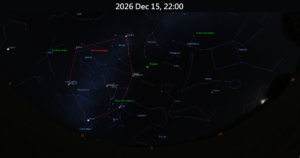
The Winter Hexagon forms a grand circle of stars: Capella, Aldebaran, Rigel, Sirius, Procyon and Pollux. It’s a stunning naked-eye asterism that showcases the richness of winter constellations, best seen from about 10 pm mid-month.
The Geminid meteor shower, which peaks on the night of December 13–14, is the year’s best. Meteors radiate from Gemini, just near Castor, visible from late evening through to dawn twilight. As with all meteor showers, look high in the sky, not at the radiant.
Jupiter shines brightly in the late evening sky and is worth looking at in binoculars or a telescope if you have them, while Saturn sets soon after midnight by the end of the month.
Binocular users can enjoy the Hyades cluster near Aldebaran and revisit the Pleiades, now high in the sky.
The Moon, especially a few days either side of first quarter (December 16) and last quarter (December 1 and 30), offers dramatic views of its terrain if you look at the ‘terminator’, the boundary between light and dark.