
November nights deepen, revealing a rich tapestry of stars. Taurus is now well placed in the southeastern sky by mid-evening, leading the way into the winter constellations. Its bright red giant Aldebaran marks the eye of the Bull, and nearby, the Pleiades (Seven Sisters) sparkle — a truly stunning sight with binoculars.
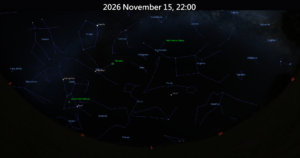
Saturn is in the southwestern sky until after midnight, but you’ll need a small telescope magnifying at least 20x to enjoy its iconic rings.
Orion begins to rise later in the evening, heralding the approach of winter. By midnight, its distinctive belt and bright stars Betelgeuse and Rigel are climbing into view. If you look below the belt, you’ll see his sword; the middle star looks a bit fuzzy. Binoculars reveal that it’s not a star at all; it’s the great Orion Nebula, a stellar nursery.
The Leonid meteor shower peaks on the night of November 17–18. Get a recliner and blanket or sleeping bag and look high in the sky after the Moon has set for fast-moving meteors radiating from Leo.